
Far(), Remotable, and Marshaling
Let's look more closely at an eventual send between vats:
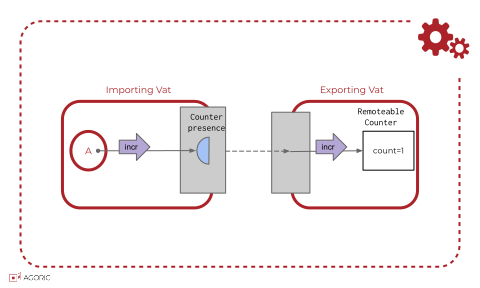
In the exporting vat, we'll take the makeCounter Hardened JavaScript example and refine it to make remotable counters by marking them with Far:
const makeCounter = () => {
  let count = 0;
  return Far('counter', {
    incr: () => (count += 1),
    decr: () => (count -= 1),
  });
};

const publicFacet = Far('makeCounter', { makeCounter });
assert(passStyleOf(publicFacet) === 'remotable');
Marshaling by Copy or by Presence
Recall that the first step in an eventual send is to marshal the method name and arguments. Marshalling is transforming a data structure into a format suitable for storage or transmission. The @endo/marshal package uses JSON, but it can handle Javascript values that cannot be expressed directly as JSON, such as undefined and BigInts.
const m = makeMarshal(undefined, undefined, smallCaps);

const stuff = harden([1, 2, 3n, undefined, NaN]);
const capData = m.toCapData(stuff);
t.deepEqual(m.fromCapData(capData), stuff);
Also, while many forms of data are copied between vats, remotables are marshalled so that they become remote presences when unmarshaled. Another vat can then make and use the exported counters:
const counter = E(publicFacet).makeCounter();
const n = await E(counter).incr();
assert(n === 1);
Pass Styles and harden
Calls to remote presences must only contain passable arguments and return passable results. A Passable is a hardened value that can be marshalled. There are four broad kinds of Passable:
- Pass-by-copy primitive values:
undefined,null, booleanstrueandfalse, numbers, BigInts, strings, and symbols that are either well-known or registered. - Acyclic pass-by-copy containers that recursively terminate in non-container passables. Such containers include CopyArrays like
harden(['foo', 'bar']), CopyRecords likeharden({ keys: [0, 1], values: ['foo', 'bar'] }), and CopyTaggeds representing types like CopySet, CopyBag, and CopyMap (which extend thepassStyleOflevel of abstraction with tag-specific shapes and semantics) - Pass-by-reference "PassableCaps":
- Remotables: objects that can be shared with remote systems which can then invoke methods using e.g.
E()eventual send notation. Remotables are created byFar()and related functions. - Promises for Passables.
- Remotables: objects that can be shared with remote systems which can then invoke methods using e.g.
- As a special case, Errors are treated as pass-by-copy data that can also contain other Passables.
Every object exported from a smart contract, such as publicFacet or creatorFacet, must be passable. All objects used in your contract's external API must be passable.
All Passables must be hardened. Consider what might happen if we had a remote item and we did not harden some pass-by-copy data that we passed to it:
let amount1 = { brand: brand1, value: 10n };
await E(item).setPrice(amount1); // Throws an error, but let's imagine it doesn't.
amount1.value = 20n;
Now amount1 is supposedly both in the local and the remote vat, but the value is 20n in the local vat but 10n in the remote vat. (Worse: the remote vat might be the same as the local vat.) Requiring harden() for pass-by-copy data leads to behavior across vats that is straightforward to reason about.
passStyleOf API
import { passStyleOf } from '@endo/pass-style';passStyleOf(passable) returns a PassStyle string that categorizes passable.
passable{Passable}- Returns:
{PassStyle}
PassStyle values correspond with the different kinds of Passable:
- Pass-by-copy primitive values:
"undefined","null","boolean","number","bigint","string", or"symbol". - Pass-by-copy containers:
"copyArray","copyRecord", or"copyTagged". - Pass-by-reference PassableCaps:
"remotable"or"promise". - Pass-by-copy Errors:
"error".
If passable is not passable (for example, because it has not been hardened or has a non-trivial prototype chain), then passStyleOf will throw an error.
Check passStyleOf when handling untrusted structured data
Just as you would use typeof to check that an argument is a string or number, use passStyleOf when you expect, say, a copyRecord; this prevents malicious clients from playing tricks with cyclic data etc.
Far() API
import { Far } from '@endo/far';Far(farName, objectWithMethods) marks an object as Remotable.
farName{ String }objectWithMethods{ Object }- Optional.- Returns: A
Remotableobject.
The farName parameter gives the Remotable an interface name for debugging purposes, which only shows up when logged through the console, for example with console.log.
The optional objectWithMethods parameter should be an object whose properties are the functions serving as the object's methods. It MUST NOT already be hardened or even frozen (though Far() will harden it before returning successfully). If not provided, a new empty object will be used.
Before succeeding, the Far() function:
- Checks that each of the object's property values are functions and throws an error otherwise.
- Accessors (i.e.,
get()andset()) are not allowed.
- Accessors (i.e.,
- Records the interface name in the object.
- Hardens the object.
Avoid accidental exports
If an object should never be exposed to other vats, you should make it a point not to use Far() on it. If an object is not marked as a Remotable but is accidentally exposed, an error is thrown. This prevents any vulnerability from such accidental exposure.
Beyond Far(): Exo Objects
Far() marks an object as remotable, but it does nothing to validate the arguments its methods receive: a caller can pass a string where a number is expected, and the method only finds out when it misbehaves partway through. This is true no matter where the call comes from: a message arriving from another vat through E() and a direct call from another object in your own vat both get exactly the same (zero) validation from Far(), so bare Far() protects local integrity no better than it protects remote integrity. For a smart contract, where every method is potential attack surface, that's not enough.
An Exo object is a Far remotable wrapped with an interface guard (from @endo/patterns), declared once with M.interface(...), that validates every method's arguments and return value automatically, before the method body ever runs:
import { makeExo } from '@endo/exo';
import { M } from '@endo/patterns';

const CounterI = M.interface('Counter', {
  increment: M.call(M.number()).returns(M.number()),
});

let count = 0;
const counter = makeExo('Counter', CounterI, {
  increment(n) {
    count += n; // n is guaranteed to be a number
    return count;
  },
});

counter.increment(5); // 5
// counter.increment('5') throws: arg 0: string "5" - Must be a number
makeExo is one of three ways to make an Exo, matching how much state management you need: makeExo for a single stateless-ish instance, defineExoClass for many instances each with their own state, and defineExoClassKit for a cohort of facets (for example, a public-facing read-only view and an admin-only write view) sharing one underlying state. Exo classes also compose with zones so that instances can be virtual (paged to disk) or durable (surviving a vat upgrade), which plain Far() objects cannot do.
Reach for Exo by default, even for an object you expect to stay inside your own vat. A guard is declared once and enforced on every call; hand-written checks scattered across method bodies (the Types: Defensive pattern from Hardened JavaScript) have to be reproduced for every method, are easy to forget on the next one added, and cannot, on their own, enforce that an argument belongs to the passable subset the way a declared guard does. Keep bare Far() only for objects with no arguments worth protecting, such as a zero-argument callback, where a guard would have nothing to check. See Exo Objects and Interface Guards for the full picture, including M.call/M.callWhen, this.state/this.self/this.facets, and getInterfaceOf.