
JavaScript Framework for Secure Distributed Computing
The Agoric smart contract platform starts with a JavaScript framework for secure distributed computing.
Watch: Distributed Programming for a Decentralized World (August 2019)
This 15 minute overview is the first in a 4-parts series of short talks on the Agoric Architecture that overlap substantially with the material in the sections below.
Vats: the Unit of Synchrony
The Agoric framework uses the same event loop concurrency model as web browsers and Node.js. Each event loop has a message queue, a call stack of frames, and a heap of objects:
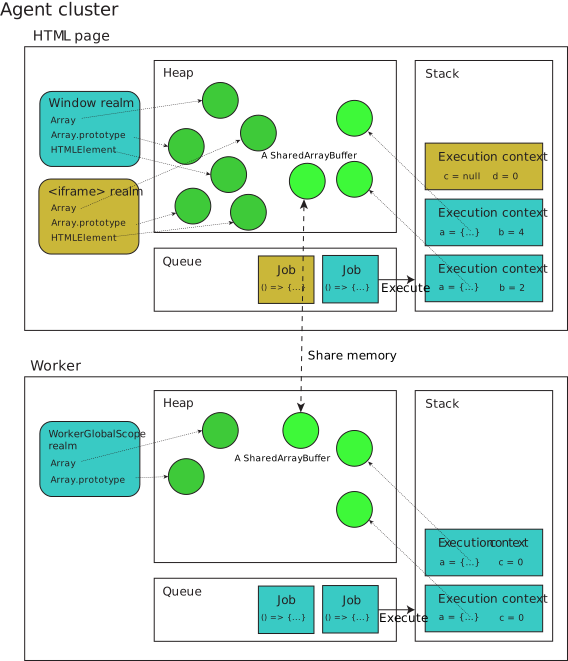
We refer to this combination of an event loop with a message queue, a stack, and a heap as a vat.
Vats are the unit of synchrony. We can only use ordinary synchronous function calls within the same vat. But we can use asynchronous function calls (with eventual send) either within the same vat or between vats. Vats may be on remote machines, including massively replicated machines such as blockchains.
Parts of the Framework
The framework includes:
- Hardened JavaScript provides a platform for making objects that can interact with code you don't completely trust, without being vulnerable to bugs or bad intentions. We introduce object capabilities and how to use them to apply the principle of least authority.
E()for Eventual Send to Remote Presences- The
E()wrapper function lets you invoke methods within or between vats. Given a local representative (a presence) for a remote object, it sends messages to the origin of the presence.E(obj).myMethod(...args)is an asynchronous form ofobj.myMethod(...args).
- The
Far(), Remoteable Objects, and Marshaling- Objects used across vats are called remotables. To mark an object for exporting from a vat, use the
Far()function.
- Objects used across vats are called remotables. To mark an object for exporting from a vat, use the
Notifiers, Subscriptions, and PublishKit
- These distribute state change updates, each delivering an asynchronous stream of messages as a publish-subscribe system might, without requiring explicit management of lists of subscribers.
makePublishKit()is the current recommended primitive, supporting both lossy and lossless consumption from a single producer.
- These distribute state change updates, each delivering an asynchronous stream of messages as a publish-subscribe system might, without requiring explicit management of lists of subscribers.
Exo Objects and Interface Guards
Far()alone doesn't validate its methods' arguments, whether the caller is remote or another object in your own vat. An Exo object (makeExo,defineExoClass,defineExoClassKit) adds a declarative interface guard, built with theMpattern language, that validates every call at the boundary, local or remote. Exo, not bareFar(), is the remotable-object surface every modern contract writes against.
- A vat can be upgraded, replacing its code while some of its state survives. Zones give the same Exo- and store-allocating code a uniform API across the three persistence regimes: heap (ephemeral), virtual (pageable, still ephemeral), and durable (pageable and upgrade-surviving).
Vows and Durable Eventual-Send
- covered in
E()for Eventual Send. Native promises don't survive a vat upgrade; a Vow is a Passable, durably storable stand-in that does, withwatch/when/watchPromiseas its.then()-equivalents. See also@agoric/async-flowfor the complementary durable-replay mechanism for entireasyncfunction bodies.
- covered in