
Eventual Send with E()
In web browsers, a common pattern of remote communication is using the asynchronous fetch API with promises:
const init = fetch('products.json')
  .then(response => response.json())
  .then(products => initialize(products))
  .catch(err => {
    console.log(`Fetch problem: ${err.message}`);
  });
In the Agoric platform, communicating with remote objects is similar, using the E() wrapper. For example, a core-eval script may want to use the Zoe Service API to install a contract on the chain. But the script cannot call zoe.installBundleID(bundleId) directly, because it does not have local access to the zoe object. However, the script is given a zoe remote presence among its permitted powers. To call methods on the actual Zoe object, the script can do:
import { E } from '@endo/eventual-send';

const installationP = E(zoe)
  .installBundleID(bundleId)
  .then(installation => {
    console.log('installed', installation);
    return installation;
  })
  .catch(reason => {
    console.error('installation failed', reason);
    throw reason;
  });
Eventual Send
One of the ways Zoe partitions risk is by running in its own vat, separate from any smart contract that might use too much compute time or heap space. The smart contracts also run in separate vats.
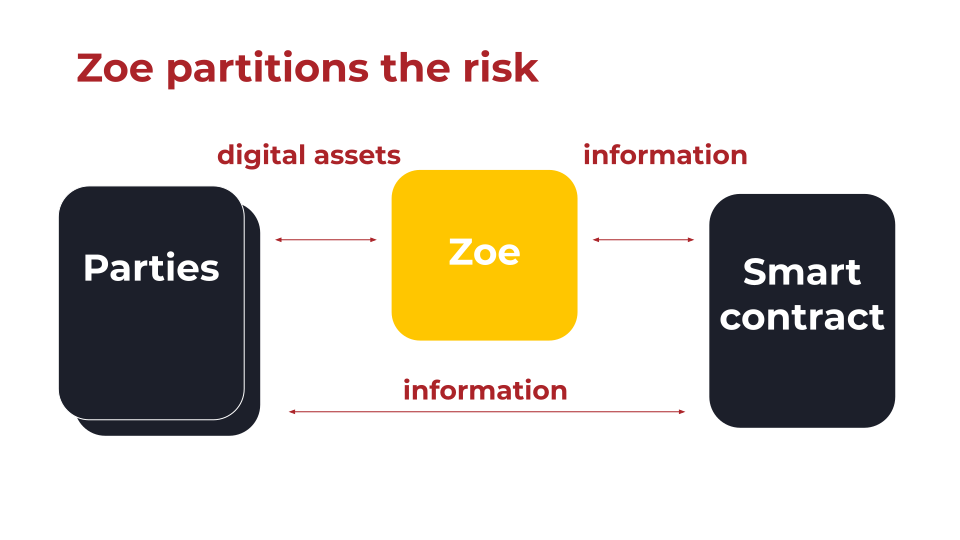
What happens when we call E(zoe).install(bundle) is an eventual send:
- A message consisting of the method name
installwith thebundleargument marshaled to a flat string and queued for delivery to the vat thatzoecomes from. E(zoe).install(bundle)returns a promise for the result.- The
thenandcatchmethods queue callbacks for when the promise is resolved or rejected. Execution continues until the stack is empty and thus this turn through the event loop completes. - Eventually
zoeresponds, which results in a new message in this vat's message queue and a new turn through the event loop. The message is de-serialized and the results are passed to the relevant callback.
This way, you can communicate with objects in separate vats as easily as objects in the same vat with one wrinkle: the communication must be asynchronous.
The E() wrapper works with:
- Remote presences (local proxies for objects in remote vats).
- Local objects (in the same vat).
- Promises for remote presences or local objects.
In all cases, E(x).method(...args) returns a promise.
Promise Pipelining
Since E() accepts promises, we can compose eventual sends: E(E(object1).method1(...args1)).method2(...args2). This way we can take advantage of promise pipelining so that a single round trip suffices for both method calls.
E.when, E.get, and E.sendOnly
E(x).method(...args) is the common case, but E exports a few more entry points for other shapes of eventual interaction:
E.when(x, onFulfilled, onRejected)is equivalent toPromise.resolve(x).then(onFulfilled, onRejected), except thatxmay be a presence, a promise, or a Vow (see Vows below), and the resolution can involve a remote round trip. PreferE.when(x)(orawait E.when(x)) overx.then(...)or bareawait xwhenxmight be a presence, since a plain promise method assumesxis already a local promise.jsimport { E } from '@endo/far'; const installationHandle = await E.when(E(zoe).install(bundle));E.get(x).propertyreturns a promise for a property of whateverxsettles to, without waiting for a method call. Reach for it when a remote call answers with a record, such as an issuer kit or a contract's terms: aFar()remotable's own properties are all methods, soE.getis for the record on the other side of a promise rather than for a presence itself.jsconst brand = await E.get(issuerKitP).brand;E.sendOnly(x).method(...args)sends a message the same wayE(x)does, but discards the result and returnsundefinedimmediately. Use it for fire-and-forget notifications where you don't need (and don't want to pay for tracking) a result promise.jsE.sendOnly(logger).record(event);
Prefer E.when(x) over x.then(...)
Since a Presence is inert (it's a marshalled reference, not a native Promise), only HandledPromise-aware operators like E, E.when, and E.get know how to route messages, get properties, and follow redirection correctly across a Vow or a disconnected/reconnected Presence. A bare .then() works today only because most values you await eventually resolve to native promises; it silently stops working the moment that value is replaced by a Vow.
Troubleshooting remote calls
The E() function creates a forwarder that doesn't know what methods the remote object has. If you misspell or incorrectly capitalize the method name, the local environment can't tell you've done so. You'll only find out at runtime when the remote object complains that it doesn't know that method.
If an ordinary synchronous call (obj.method()) fails because the method doesn't exist, the obj may be remote, in which case E(obj).method() might work.
Testing with Deep Stacks
To get stack traces that cross vats:
TRACK_TURNS=enabled DEBUG=track-turns yarn test test/contract.test.jsSee:
Vows and Durable Eventual-Send
Everything above works whether or not the vats involved are ever upgraded. But a native JavaScript Promise cannot be stored in a durable store: if a vat is upgraded while a client holds a promise for one of that vat's results, the promise is lost, and the client hangs forever waiting for a resolution that will never come.
A Vow (from @agoric/vow) is a Passable, durably storable stand-in for a promise. Any code that expects to survive its own vat's upgrade, or that hands out a result to a client that might survive the result's originating vat's upgrade, should traffic in Vows rather than raw promises for anything long-lived.
prepareVowTools(zone) returns the tools bound to a particular zone's durable storage:
import { prepareVowTools } from '@agoric/vow';
import { makeDurableZone } from '@agoric/zone/durable.js';

// Once, at the start of a vat incarnation:
const zone = makeDurableZone(baggage);
const { watch, when, makeVowKit } = prepareVowTools(zone);when(vowOrPromise)returns a promise for the vow's eventual fulfillment. It retries automatically across a disconnection caused by an upgrade of some other vat in the chain, but like any plain promise, it cannot itself survive an upgrade of the vat that'sawaiting it.watch(vowOrPromise, watcher, context)subscribes a durablewatcherobject (withonFulfilled/onRejectedmethods) to a Vow. Because the watcher and itscontextare durable Exo state rather than a closure, the subscription survives an upgrade of both the vat producing the Vow and the vat consuming it: on resume, the new incarnation'swatchcall finds the still-pending Vow in baggage and picks up where it left off. This is the durable-replay-safe way to react to a long-running result.makeVowKit()makes a{ vow, resolver }pair analogous to a promise's executor: hand thevowto a caller, keep theresolverto settle it later, potentially in a different vat incarnation than the one that created it.- For code that isn't itself durable but calls into vats that use Vows, use the plain
Efrom@endo/far:Ealready treats a settled Vow the way it treats a promise, soawait E(x).method()works whetherx's vat answers with a promise or a Vow. watchPromise(promise, watcher, ...watcherArgs)(from@agoric/base-zone) is the analogous durable subscription for an ordinary (non-Vow) promise: use it instead ofpromise.then(...)whenever the watcher needs to survive an upgrade of the watching vat, even though the promise itself is native and non-durable.
Vows vs. plain E()
For request/response calls that complete within a single turn or two, plain E() is simpler and remains the right default. Reach for Vows specifically when a result might still be outstanding across a vat upgrade: long-running orchestration flows, cross-chain calls, or any handle you hand to a client you expect to hold onto for a while. See async-flow for the complementary durable-replay mechanism for whole async function bodies (not just individual awaited values), which is built on Vows.
E() and Marshal: A Closer Look
Watch: Office Hours Discussion of Marshal
If you just want to use the SDK to write smart contracts, feel free to skip this section. But in case you're working on something that requires more detailed understanding, let's take a look at how E(x).method(...args) is marshalled.
In @endo/marshal docs, we see:
The
marshalmodule helps with conversion of "capability-bearing data", in which some portion of the structured input represents "pass-by-proxy" or "pass-by-presence" objects that should be serialized into values referencing special "slot identifiers". ThetoCapData()function returns a "CapData" structure: an object with abodycontaining a serialization of the input data, and aslotsarray holding the slot identifiers.fromCapData()takes this CapData structure and returns the object graph. There is no generic way to convert between pass-by-presence objects and slot identifiers, so the marshaller is parameterized with a pair of functions to create the slot identifiers and turn them back into proxies/presences.
For example, we can marshal a remotable counter using the slot identifier c1:
const makeCounter = () => {
  let count = 0;
  return Far('counter', {
    incr: () => (count += 1),
    decr: () => (count -= 1),
  });
};

const counter1 = makeCounter();
t.is(passStyleOf(counter1), 'remotable');

const valToSlot = new Map([[counter1, 'c1']]);
const slotToVal = new Map([['c1', counter1]]);
const convertValToSlot = v => valToSlot.get(v);
const convertSlotToVal = (slot, _iface) => slotToVal.get(slot);
const m = makeMarshal(convertValToSlot, convertSlotToVal, smallCaps);

const capData = m.toCapData(counter1);
t.deepEqual(capData, {
  body: '#"$0.Alleged: counter"',
  slots: ['c1'],
});
t.deepEqual(m.fromCapData(capData), counter1);
Each end of a connection between vats typically keeps a table to translate slots to capabilities and back:
const makeSlot1 = (val, serial) => {
  const prefix = Promise.resolve(val) === val ? 'promise' : 'object';
  return `${prefix}${serial}`;
};

const makeTranslationTable = (makeSlot, makeVal) => {
  const valToSlot = new Map();
  const slotToVal = new Map();

  const convertValToSlot = val => {
    if (valToSlot.has(val)) return valToSlot.get(val);
    const slot = makeSlot(val, valToSlot.size);
    valToSlot.set(val, slot);
    slotToVal.set(slot, val);
    return slot;
  };

  const convertSlotToVal = (slot, iface) => {
    if (slotToVal.has(slot)) return slotToVal.get(slot);
    if (makeVal) {
      const val = makeVal(slot, iface);
      valToSlot.set(val, slot);
      slotToVal.set(slot, val);
      return val;
    }
    throw Error(`no such ${iface}: ${slot}`);
  };

  return harden({ convertValToSlot, convertSlotToVal });
};
Each call to E(rx) makes a proxy for the reciver rx; each E(rx).p property reference invokes the get proxy trap. From the get trap, E returns a function that queues rx, p, and its arguments (in marshalled form) and returns a promise:
const { convertValToSlot, convertSlotToVal } =
  makeTranslationTable(makeSlot1);
const m = makeMarshal(convertValToSlot, convertSlotToVal, smallCaps);

const outgoingMessageQueue = [];
// E work-alike for illustration
const E2 = obj =>
  new Proxy(obj, {
    get:
      (target, method) =>
      (...args) => {
        const msg = harden([target, [method, args]]);
        outgoingMessageQueue.push(m.toCapData(msg));
        return new Promise(_resolve => {});
      },
  });
Now we can see the result in some detail. Note the way the promise from E(zoe).install() is passed to E(zoe).startInstance().
const zoe = Far('ZoeService', {});
const bundle = { bundleFormat: 'xyz' };
const installationP = E2(zoe).install(bundle);
const startP = E2(zoe).startInstance(installationP);
harden(startP); // suppress usage lint
t.deepEqual(outgoingMessageQueue, [
  {
    body: '#["$0.Alleged: ZoeService",["install",[{"bundleFormat":"xyz"}]]]',
    slots: ['object0'],
  },
  {
    body: '#["$0.Alleged: ZoeService",["startInstance",["&1"]]]',
    slots: ['object0', 'promise1'],
  },
]);
Watch: How Agoric Solves Reentrancy Hazards (November 2020)
for more on eventual send and remote communication